



Hotels



¿Need help?
We are here to help you!
Call us for free at
08000 211953
Monday to friday (08:00 to 19:30) (GMT+1)
Saturday and holidays (09:00 to 17:00) (GMT+1)

Ecotax in Mallorca 2026: A mathematical guide on how much you'll pay at your hotel and who is exempt
Elisabeth Blue
-
8/17/26
The Tax on Tourist Stays (IET), colloquially known throughout the Mediterranean region as the Ecotax, is a regional tax figure of a compulsory and non-negotiable nature in the autonomous community of the Balearic Islands. Regulated by Law 2/2016 of the Balearic Parliament, and with successive fiscal updates applicable in this statistical year of 2026, this tax directly levies the stay of any traveller in the regulated tourist accommodation of Mallorca, Menorca, Ibiza and Formentera. Its legislative purpose is the collection of a state-earmarked fund destined exclusively to finance environmental regeneration projects, historic heritage restoration, improvement of water infrastructure and preservation of protected natural spaces subjected to high human pressure.
At Hotels VIVA, we advocate for maximum budgetary and financial transparency. We believe that the economic planning of a family holiday on the Mallorcan coast demands accuracy down to the last cent, keeping any possibility of operational surprises or unforeseen surcharges at the reception desk during the check-in registration process at bay. A common mistake among first-time travellers is to budget the final price of their stays based solely on the nominal base rate of the tax, overlooking the fact that European tax regulations impose the obligation to levy said transaction with Value Added Tax (VAT).
The strict aim of this technical, analytical guide is to provide a comprehensive financial X-ray of the Ecotax in Mallorca for the year 2026. We break down the official rate tables in force calculated with 10% VAT included, we will explain the exact algebraic formula for taxation according to the timing of your trip, we will review in detail the regulatory framework of exemptions by age and we provide real step-by-step spending simulations so that you know in advance the exact impact of this tax on the budget of your next holiday.
Official 2026 rate matrix (daily prices with VAT included)
To avoid accounting mismatches in your forecasts, we have structured the following financial matrix. In it, we not only reflect the base tax rate set by the Balearic Tourist Stays Law, but also the exact final amount —with the 10% surcharge of the regional VAT on hospitality services incorporated— that will physically be paid per person and day of overnight stay, linking each tax tier to our reference establishments in the north and east of the island.
|
Accommodation category |
Base rate (High season: May - Oct) |
Real rate with 10% VAT (Pay per pax/day) |
Base rate (Low season: Nov - Apr) |
Real low rate with VAT (Pay per pax/day) |
Reference Hotel VIVA |
|
5-Star and 4-Star Superior Hotels* |
€4.00 |
€4.40 |
€1.00 |
€1.10 |
VIVA Blue & Spa / VIVA Cala Mesquida Resort & Suites |
|
4-Star and 3-Star Superior Hotels* |
€3.00 |
€3.30 |
€0.75 |
€0.83 |
VIVA Sunrise / VIVA Eden Lago |
|
1, 2 and 3-Star Hotels |
€2.00 |
€2.20 |
€0.50 |
€0.55 |
Other regulated coastal options |
|
Tourist Apartments (4 keys) |
€4.00 |
€4.40 |
€1.00 |
€1.10 |
VIVA Cala Mesquida Suites & Spa (Specific sectors) |
|
Holiday Rental Homes (ETV) |
€2.00 |
€2.20 |
€0.50 |
€0.55 |
Subject to independent tourism legislation |
How the Ecotax is calculated: mathematical formula and operational variables
The calculation of the final amount that will appear on your invoice is neither linear nor static; it responds to the product of a multiplication of three interdependent variables that drastically modify the final accounting sum according to the configuration of your trip.
The Timing factor (Tax seasonality)
Balearic legislation strictly and immovably divides the fiscal calendar into two clearly differentiated half-years:
- High season (From 1 May to 31 October): Coinciding with the greatest international influx and the maximum pressure on the island's hydrological and natural resources, the Balearic Government applies 100% of the base tax burden set in the official table.
- Low season (From 1 November to 30 April): To encourage tourism deseasonalisation and keep hotel infrastructure active in winter, the law establishes an automatic 75% discount on the tax rate. A guest staying at our operational establishments in April or November will pay only a quarter of what they would pay for the same room in the month of August.
The tax levy of European Law (The 10% VAT factor)
There is a recurring question in the sector: why does a governmental ecological tax carry an added VAT surcharge? The answer lies in the legal collection mechanism. The Government of the Balearic Islands does not have a delegated administrative infrastructure at airports or ports for the direct collection of this tax from visitors. By legislative order, hotel and tourist accommodation companies are appointed as substitute taxpayers of the contributor.
This means that, legally, the establishment acts as an intermediary collection agent that invoices the overnight stay service levied by the tax, collects it from the guest and settles it quarterly with the Tax Agency of the Balearic Islands (ATIB). As it is a chargeable concept that is compulsorily integrated into a hospitality services invoicing document issued within the European Union, Spanish legislation prevails over the regional rule, requiring the application of 10% Value Added Tax on the base amount of the tax.
The structural categorisation of the establishment
The third multiplier is the official classification of the hotel granted by the Tourism Department of the Balearic Government. The tax logic of the IET is progressive and is governed by the principle of economic capacity and theoretical ecological footprint. Therefore, a room in a complex catalogued as 4-Star Superior, equipped with extensive landscaped areas, semi-Olympic pools and multiple themed restaurants —as is the case with VIVA Blue & Spa in Playa de Muro or VIVA Cala Mesquida Resort & Suites— accrues a base rate of €4.00 (€4.40 with VAT), while a standard 4-Star establishment, such as our hyper-connected VIVA Sunrise in Puerto de Alcúdia, places its tax tier at €3.00 base (€3.30 with daily VAT per adult).

Official exemptions and discounts: the regulatory savings framework
To avoid overly taxing families and to reward the loyalty of long-stay tourism, Law 2/2016 of the IET incorporates in its articles a set of tax exemptions and discounts of direct and automatic application that represent substantial economic relief.
Absolute exemption by age (Under 16s)
This is the golden rule for family tourism in the Balearic Islands: all minors under 16 years of age are 100% exempt from paying the Tax on Tourist Stays.
It is essential to clarify the exact chronological limits of this rule: the exemption is valid from 0 to 15 years of age completed. At the precise moment when the minor turns 16 years old —taking the exact day of arrival at the establishment and the completion of check-in as the reference date—, they become considered an adult taxpayer for tax purposes, having to pay the rate in full. For a large family or a couple travelling with two or three school-age children, this regulatory point represents a saving that can easily exceed €70 on a one-week stay.
The 50% discount for long stays (From the 9th night onwards)
The Balearic legislator introduced a financial incentive for those travellers who decide to remain for long periods in the archipelago, contributing to a tourism model of lower turnover. The regulations establish that, from the ninth consecutive overnight stay and successive ones, the amount of the tax rate will be automatically reduced by 50%.
For this discount to be applicable, two strict legal conditions must be met:
- The nights must be absolutely consecutive and uninterrupted over time.
- The stay must compulsorily take place within the same hotel establishment. If a traveller stays 5 nights at one complex and subsequently moves to another resort for an additional 5 nights, the tax counter resets from zero when the second check-in is carried out, losing the right to the 50% discount on both bookings as they are considered independent commercial transactions.
Exceptional administrative exemptions
Apart from the criteria of age and stay, the law contemplates a restrictive quota of collection exemptions applicable only after documentary justification at the time of registration:
- People who travel to the Balearic Islands for reasons of unforeseeable force majeure (such as natural disasters or serious health emergencies).
- Travellers whose stays are subsidised by social programmes of European or Spanish public administrations aimed at the elderly or at the integration of vulnerable groups (such as places managed by IMSERSO).
- Federated athletes who stay at the establishments to participate in official competitions or sporting training camps formally recognised by the Government of the Balearic Islands (a point of special relevance in sports complexes specialised in triathlon and cycling such as VIVA Blue & Spa).
Real spending simulation: step-by-step algorithmic demonstration
To eliminate any algebraic ambiguity and provide maximum technical precision to the calculation of your holiday budget, we develop below two practical cases based on real booking profiles, detailing the operational breakdown that our computer systems will process on your arrival at reception.
Case A: Family of 4 at VIVA Sunrise (4-Star - High Season)
Trip parameters: Stay in August (High Season) at the family resort VIVA Sunrise (Puerto de Alcúdia), formally catalogued as a 4-Star establishment.
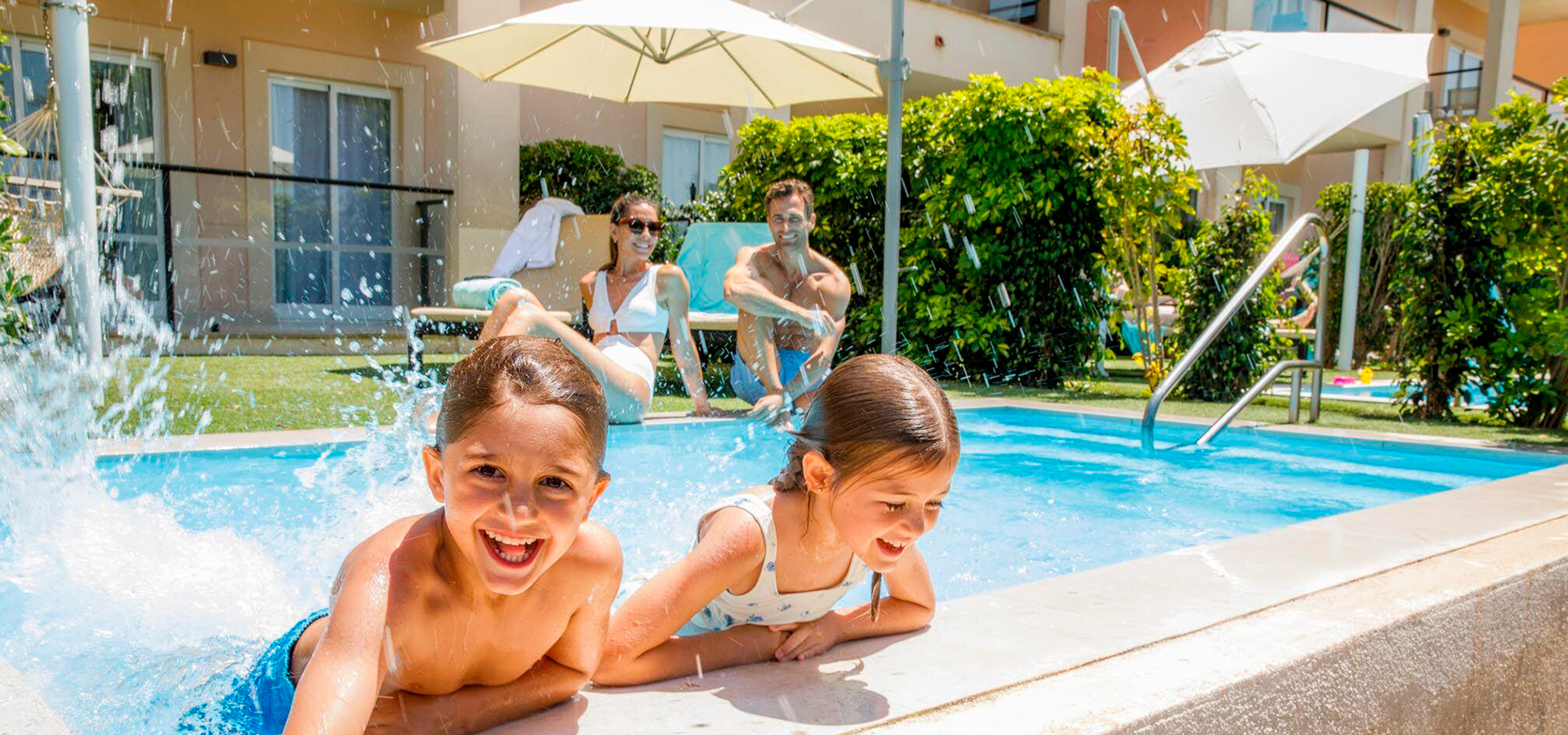
Family composition: 2 adults (aged 38 and 36) and 2 children (aged 7 and 11).
Duration of stay: 7 consecutive nights.
Calculation breakdown:
- Step 1 (Rate determination): As it is high season and a 4-Star hotel, the applicable rate is €3.00 + 10% VAT = €3.30 per person and day.
- Step 2 (Application of exemptions): The two minors are 7 and 11 years old respectively. As both are under 16, their tax rate is €0.00.
- Step 3 (Calculation of short stays for adults): As it is a 7-night booking (below the 9-night threshold for the long-stay discount), 100% of the days are invoiced at the full rate.
Algebraic operation: $2\text{ adults} \times €3.30 \times 7\text{ nights} = €46.20$.
Final IET cost to be paid at check-in: €46.20 in total for the whole family.
Case B: Couple at VIVA Cala Mesquida Resort & Suites (4* Superior - Long Stay)
Trip parameters: Stay in the month of July (High Season) at VIVA Cala Mesquida Resort & Suites, catalogued as a 4-Star Superior establishment.
Group composition: 2 adults on a couple's trip.
Duration of stay: 11 consecutive nights at the same resort.
Calculation breakdown:
- Step 1 (Base rate determination): As it is a 4* Superior category in a summer month, the standard rate levied with VAT stands at €4.40 per person and day.
- Step 2 (Chronological segmentation of the discount):
- The first 8 nights are invoiced at 100% of the legal levy: $2\text{ adults} \times €4.40 \times 8\text{ nights} = €70.40$.
- From night number 9 (inclusive), that is, for days 9, 10 and 11 (3 nights in total), the legal 50% discount comes into force. The daily rate becomes $€4.40 / 2 = €2.20$ per passenger.
- Calculation of the discounted section: $2\text{ adults} \times €2.20 \times 3\text{ nights} = €13.20$.
- Step 3 (Sum of items): $€70.40 + €13.20 = €83.60$.
Final IET cost to be paid at reception: €83.60 for the whole stay.
Logistical operations and tangible return at Hotels VIVA
At Hotels VIVA, we conceive the payment of the Tax on Tourist Stays not as a mere bureaucratic tax burden, but as a direct and verifiable investment in the protection of the scenic and human environment that gives meaning to the experience of travelling to the Mediterranean. So that the logistical procedure runs with total fluidity on your arrival, we have standardised our corporate collection protocol at all our reception desks.
The settlement protocol at the hotel: Why isn't it charged online?
Many of our clients ask us with surprise why the Ecotax does not appear included and paid in the payment gateway when finalising their online booking through our website or an external travel agency. The reason is strictly legal and one of governmental audit.
The legislation of the Tax Agency of the Balearic Islands (ATIB) explicitly prohibits the advance electronic collection of the stays tax before reliably verifying the identity, real date of birth (to apply the exemption for under-16s) and the exact number of passengers who physically occupy the room at the time of the entry registration. Consequently, the settlement of the amount is always carried out at the reception desk of our hotels, issuing an invoice separate from the cost of the accommodation, either during the welcome procedure (check-in) or in the final settlement of the stay (check-out). You can pay this amount with any international credit or debit card, or in cash, without this generating any type of management commission on our part.
Where exactly does the money you pay at the desk of our complexes go? Each euro collected enters an earmarked account managed by a Commission for the Promotion of Sustainable Tourism made up of scientific, environmental and governmental administrations. By choosing to stay at our resorts, your Ecotax generates a direct and immediate return in the geographical ecosystem that surrounds you:
- In the northern area (Alcúdia and Muro): By staying at establishments such as VIVA Blue & Spa or VIVA Eden Lago, your taxation co-finances the hydrological regeneration plans and repopulation of native flora in the neighbouring S'Albufera Natural Park. This marshland mass, the most important protected wetland in the Balearics, acts as a green lung and a biological filter that guarantees the quality and crystalline purity of the waters at Playa de Muro, preserving the fragile habitat of more than two hundred species of migratory birdlife.
- In the east of Mallorca (Capdepera): If you opt for our exclusive seafront at VIVA Cala Mesquida Resort & Suites, the Ecotax fund finances the forest surveillance and the costly maintenance of the elevated wooden walkways and vegetation fixation systems that protect the imposing dune system of Cala Mesquida. This continuous investment prevents the retreat of the sand caused by wind erosion and the transit of bathers, safeguarding one of the wildest, most spectacular and best-preserved coastal landscapes in the entire Mediterranean Sea.
Frequently asked questions about the legal framework of the Ecotax (FAQ)
To resolve the more advanced procedural and legal doubts that habitually arise among international and family trip planners, our legal and concierge team responds with regulatory rigour to the following key questions:
Is the Ecotax included and paid when I book an "All Inclusive" tourist package through an international tour operator or a physical travel agency?
In practically 100% of cases, the answer is no. The international commercial regulations of tour operators and travel agencies in Europe scrupulously separate the cost of the transport, transfer and hotel board package (whether Half Board, Full Board or All Inclusive) from the local and governmental destination taxes. Tourism intermediation contracts establish that stay taxes must be settled in person by the end user directly with the accommodation establishment in local currency or by bank card. When checking in at our hotels with an All Inclusive voucher from an external provider, the Ecotax must be paid at the reception desk before accessing the suite.
What official documentation must I present at hotel reception to prove that my children are under 16 and to have the total exemption from the charge applied to them?
So that our computer systems can apply the legal 100% discount on the taxation of minors, the Balearic tourism inspection regulations require verification by means of reliable identity documentation. At the time of carrying out the entry registration (check-in), the responsible adults must present the National Identity Document (DNI), the valid Passport, or else the official Family Book where the date of birth of the accompanying children expressly appears. Student cards, children's credit cards or simple verbal sworn statements are not admitted as valid proof. Once the real date of birth has been entered and verified in our system, the exemption is applied instantly on the overall invoice.
If I decide to divide my holiday in Mallorca and stay 5 nights at a hotel in the north and another 5 nights at a resort in the south or east of the island, do the days of stay accumulate so that I can benefit from the 50% discount from the ninth day onwards?
No, under no circumstances. The regulatory article of IET Law 2/2016 that governs the long-stay discount is emphatic: the 50% discount applicable from day 9 of overnight stay onwards is inextricably conditioned on continuous and uninterrupted permanence within the same hotel operating unit (the same physical hotel). If a guest divides their 10-day holiday between two different establishments —even if both complexes belong to the same chain or commercial brand—, the Tax Agency's time count is cut at the moment the check-out from the first establishment is carried out. On entering and signing the entry registration at the second hotel, the tax counter irremediably resets on day number 1, losing the right to accrue the 50% reduced rate in either of the two fractioned periods. Therefore, centralising your holiday in a single base camp like Hotels VIVA not only optimises your logistics and holiday comfort, but also brings a direct mathematical benefit from the ninth overnight stay.

Post Relacionados










Your happiness is our reward

Best online price

Discount on future stays

Discount at Balneum Spa

Discounts on room upgrades
