



Hotels



¿Need help?
We are here to help you!
Call us for free at
08000 211953
Monday to friday (08:00 to 19:30) (GMT+1)
Saturday and holidays (09:00 to 17:00) (GMT+1)

The maths of booking: Early booking vs. Last minute in Mallorca (Cost simulation)
Elisabeth Blue
-
9/9/27
"Last minute" booking as a financial strategy for finding low prices in Mallorca during the high season no longer exists. In today's hotel and aviation industry, waiting until July in the hope of landing a discounted residual fare to travel in August is a logistical mistake that guarantees a severe extra cost. Nowadays, prices aren't governed by human intuition or the need to offload inventory at any price; instead, they're controlled by predictive Yield Management algorithms.
The aim of this article is to demonstrate, in algorithmic and financial terms, why the Early Booking strategy is mathematically superior to the Last Minute one, breaking down the hidden logistical costs that come with delaying the decision to buy your holiday on the island.
1. Contrasting the strategies
To visualise the impact of timing on the buying decision, we've laid out the operational and financial variables that separate a planned winter booking from a reactive summer purchase.
|
Logistical variable |
'Early booking' strategy (January – March) |
'Last minute' strategy (June – July) |
|
Hotel base rate |
Minimum (Guaranteed algorithmic discounts of 15% to 25%) |
Maximum (Rack rate with no discounts due to high demand pressure) |
|
Cost of flights to PMI |
Low (High availability in the first booking classes or buckets) |
Critical (Exponential extra cost due to seat scarcity) |
|
Choice of room type |
Total (Access to family suites, ground floors and premium views) |
Residual (Standard rooms or inventory returned through cancellations) |
|
Financial risk |
None (Frozen rates and flexible cancellation policies active) |
High (Total budget uncertainty and the risk of being left stranded) |

2. How 'Yield Management' works
To understand why prices rise, you need to look at the booking engine from an algebraic perspective. Dynamic pricing systems assess, in real time, the speed at which bookings come in (the pick-up) and the remaining availability.
The dynamic rate formula
In its most simplified version, the algorithm calculates the final room price using a multiplier based on scarcity. If we define the dynamic rate as $P(x)$, the base or floor rate as $P_0$, the current occupancy factor as $x$ (where $0 \le x \le 1$), and the demand elasticity constant in August as $k$, the model responds to an exponential function:
$P(x) = P_0 \cdot e^{k \cdot x}$
- The price floor (Early booking scenario): In January ($x \approx 0.1$), the hotel needs to secure a base volume of early occupancy to cover its fixed operating costs (break-even point). The algorithm applies the floor price ($P_0$) and combines it with Early Booking campaigns, applying a direct discount. This is the moment when the mathematical curve entirely favours the buyer.
- The price ceiling (Last minute scenario): As we approach July and the occupancy factor exceeds 85% ($x \approx 0.85$), the algorithm detects scarcity. The last 15 available rooms are statistically the most sought-after. The constant $k$ shoots up and the system automatically applies a marginal surcharge. There's no longer any need to incentivise sales through discounts, as demand vastly outstrips the residual supply.
3. The hidden logistical cost: flights and island infrastructure
Analysing the budget for a trip to Mallorca can't be limited to the overnight stay. The destination is an island, which adds two logistical bottlenecks that financially penalise anyone booking at the last minute.
The funnel effect of Palma Airport (PMI)
There's no point finding a hotel room at an acceptable price in July if the cost of air travel wipes out the saving. Airlines operate under an even more aggressive Yield Management system than the hotel sector, dividing the plane's seats into booking classes (buckets). The first seats on a flight to Mallorca in August are sold in the cheapest classes during January and February. When a traveller tries to buy a ticket only three weeks in advance, the airline's system only has the highest fare classes available (Y or B), easily tripling the price of the ticket.
Legislation on hire vehicles in the Balearics
A hidden cost that surprises Last Minute travellers is internal mobility. For reasons of environmental sustainability, the Government of the Balearic Islands applies regulations that limit the size of the hire car (Rent a Car) fleets that can operate on the island during the high season. This legal restriction creates a supply shortfall in July and August. If you don't book your vehicle months in advance, hiring a standard family car in August can reach daily rates that exceed the cost of the hotel room itself, completely unbalancing the trip's cost structure.
4. Real spending simulation: a practical case
To illustrate the financial impact, we'll run a spending simulation based on average market prices for a standard family of four (two adults and two children) planning a 7-night holiday in the second half of August. We compare the two timing scenarios for the purchase: the cost of Early Booking versus the cost of Last Minute.
Scenario A: booking in January
- Accommodation: Base rate of £250/night. The January algorithm applies a promotional Early Booking discount of 20%.
- Daily cost: £200
- Subtotal (7 nights): £1,400
- Flights to PMI: Advance purchase in the first fare buckets.
- Cost per passenger: £80.
- Subtotal (4 pax): £320
- Hire car: Early booking secured within the base fleet.
- Daily cost:£40
- Subtotal (7 days): £280
- Total cost: £2,000
Scenario B: booking in late July
- Accommodation: Hotel occupancy at 90%. The algorithm cancels any discount and applies the maximum Rack rate due to scarcity.
- Daily cost: £300
- Subtotal (7 nights): £2,100
- Flights to PMI: Only seats in the highest residual fare classes remain.
- Cost per passenger: £220
- Subtotal (4 pax): £880
- Hire car: Island fleet sold out. The last units go at luxury prices.
- Daily cost: £95
- Subtotal (7 days):£665
- Total cost: £3,645
The mathematical conclusion of the case
Calculating the difference gives an extra cost of £1,645. Mathematically, delaying the purchase decision by six months means an exact increase of 82.25% over the initial budget, while obtaining exactly the same service at the destination.
5. Hotels VIVA: the guarantee of choosing your infrastructure
The financial factor isn't the only casualty of Last Minute; the quality of the spatial and logistical experience drops drastically too. At Hotels VIVA, the design of our complexes includes highly specialised room types. Early Booking isn't just a money-saving tool — it's the only way to guarantee access to the specific infrastructure your travel profile requires.
The family space variable
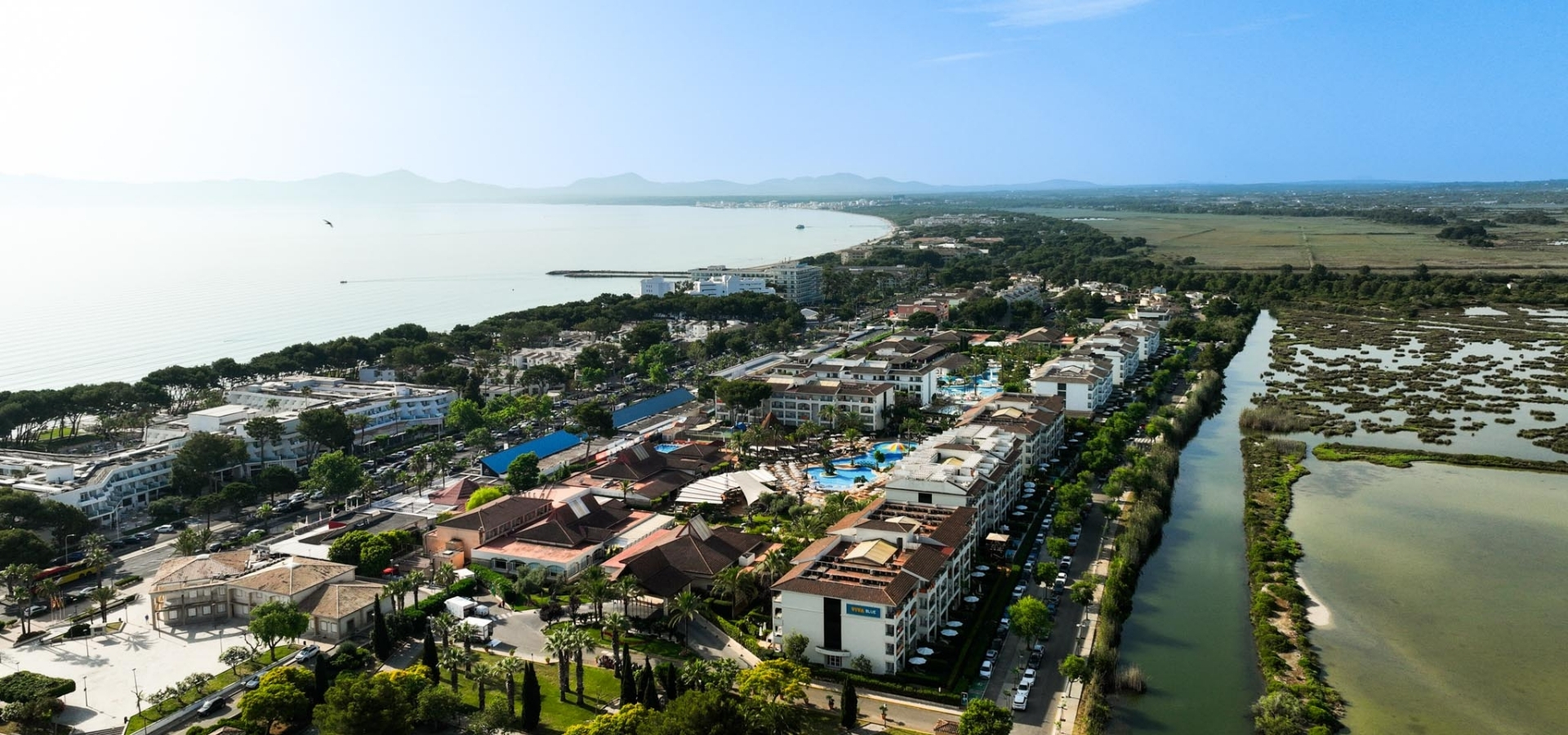
If you're travelling with young children and staying in complexes such as VIVA Eden Lago (facing Lago Esperanza) or the extensive VIVA Sunrise in Puerto de Alcúdia, the logistical needs are rigid. You'll want ground-floor apartments with a private garden to avoid using lifts with pushchairs, Swim-Up rooms (with direct pool access from the terrace) or suites located in low-noise areas. These premium room types operate with limited inventory and are, without fail, the first to sell out. In a March-purchase scenario, the traveller locks in these units; in a July-purchase scenario, the family is relegated to the standard rooms left vacant.

The demand for geographical isolation
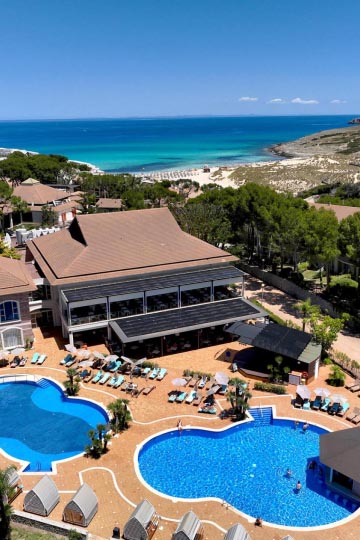
The same applies to the Slow Luxury segment and contact with unspoilt nature. Our VIVA Cala Mesquida Resort & Spa complex is integrated into a protected dune system on the east of the island. The suites with clear, front-facing views of the Mediterranean Sea experience extremely high demand turnover. Waiting until the last minute at this kind of resort means missing the chance to wake up facing the blue horizon.
The logistical risk for the sports traveller
Last Minute is especially harmful for active tourism. If a road cyclist or triathlete delays their spring booking at technical establishments such as VIVA Blue & Spa or the adults-only retreat VIVA Golf Adults Only 18+, they face an infrastructure problem. Even if the algorithm lets them find a room, it's highly likely that the number of secure spaces in our Cycling Station (where carbon bikes must be stored overnight with video surveillance and anchored locks) will be at 100% capacity, jeopardising the viability of their training on the island.

The financial safety net (Flexible cancellation)
The only rational argument for avoiding Early Booking used to be the fear of medical or work emergencies before the travel date. At Hotels VIVA, we've neutralised this financial risk. Our early booking system includes rates with flexible cancellation policies, letting you change the dates or cancel the booking without penalty under the conditions set out on our official website. This way, the guest secures the algorithm's minimum rate in January, locks in the exact suite type they need, and keeps their operational safety net fully intact.
6. Frequently asked questions about booking strategies (FAQ)
To lay the technical groundwork for your planning, our Revenue Management department answers the most recurring financial questions about rate fluctuations in Balearic hotels.
How far in advance should I book to be guaranteed the best 'Early booking' price in Mallorca?
Based on the algorithmic price history, the window of greatest financial efficiency for stays between June and September opens between 15 December and 28 February. During this ten-week period, booking engines apply the maximum base discount to secure the critical volume of early occupancy, and the availability of flights and hire vehicles stays at its lowest-cost stage.
Do 'Last minute' deals in August really exist on the island?
At a family and logistical level, no. Today's Last Minute in Mallorca doesn't stem from organised sales campaigns, but from occasional, unforeseen cancellations by other guests. This kind of residual inventory can be worthwhile solely and exclusively for solo travellers or couples who fly without checked luggage, who have complete date flexibility (they can fly at dawn on a Tuesday) and who don't mind changing hotel or area of the island. For structuring a rigid family holiday that requires connecting rooms, Last Minute is financially unfeasible.
If the algorithmic room price drops unexpectedly after I've booked with Early booking, can I claim the difference?
Yes. By making your booking directly through the official Hotels VIVA website, your purchase is protected under the Best Price Guarantee policy. If at any point after your confirmation you find the same room type, on the same dates and under the same board and cancellation conditions at a lower price on our official channel, our customer service team will automatically match the rate, ensuring your financial forecast is never penalised.

Post Relacionados















Your happiness is our reward

Best online price

Discount on future stays

Discount at Balneum Spa

Discounts on room upgrades
